Call Tracker
See what makes your phone ring.
Every call tied back to the campaign, keyword, and ad that drove it. Call recording, SMS, and real time reporting included.
Unlimited users. No contracts.
WhatConverts vs CallRail: Pricing, Lead Types, and Which One Fits
WhatConverts and CallRail both tell you which marketing produced an inbound lead. They divide the problem differently, and that difference decides which one is cheaper for you.
WhatConverts is built around the idea that a lead is a lead, whether it arrives as a call, a form submission, or a chat. CallRail starts from calls and texts, then sells form tracking as a higher tier.
Call Tracker publishes this comparison and competes with both. Prices below were taken from each provider’s own pricing page, and both are linked so you can verify the current figures.
The Short Answer
Choose WhatConverts if you capture leads through forms and chat as well as calls, and you want them in a single attribution report without climbing a pricing tier.
Choose CallRail if phone calls are the lead type that matters, you want numbers and minutes bundled into the plan price, and you would rather not manage a separate usage bill.
Consider Call Tracker if calls are your focus and you want more included usage than either offers at the entry price.
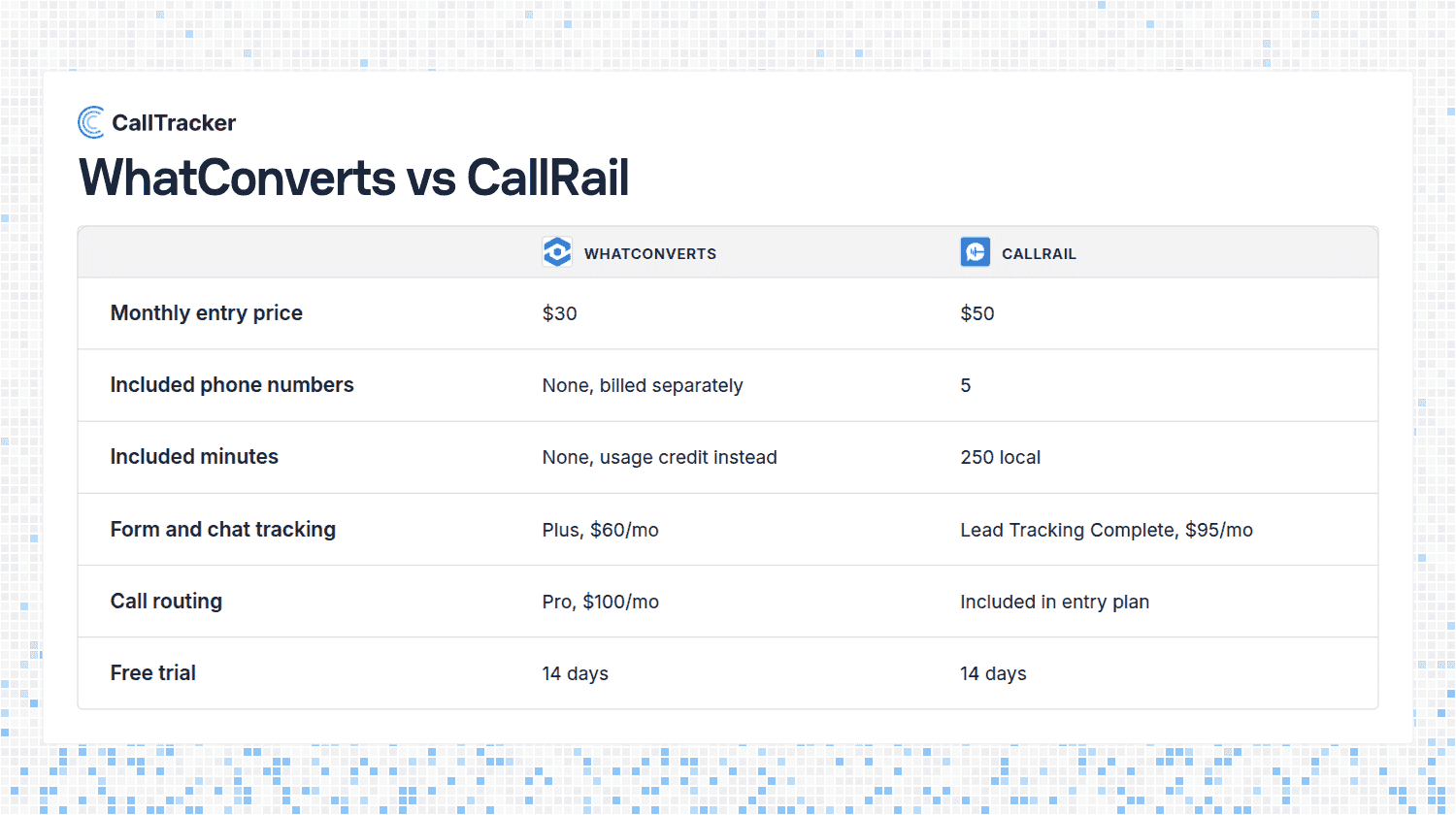
WhatConverts vs CallRail at a Glance
| Category | WhatConverts | CallRail |
|---|---|---|
| Monthly entry price | $30 | $50 |
| Included phone numbers | None, billed separately | 5 |
| Included minutes | None, usage credit instead | 250 local |
| Entry plan includes | $30 usage credit, up to 148 call leads | 5 numbers, 250 minutes, 25 texts |
| Form and chat tracking | Plus, $60/mo | Lead Tracking Complete, $95/mo |
| Call routing | Pro, $100/mo | Included in entry plan |
| Advanced attribution | Elite, $160/mo (Customer Journey, multi-click) | Lead Conversion, $150/mo |
| Number cost | Local $1.75 to $2.50 each, toll-free $3.00 to $3.50 | Extra local $3, extra toll-free $5 |
| Agency plans | Published: $500, $800, $1,250 for unlimited accounts | Not listed alongside the four standard plans |
| Free trial | 14 days | 14 days |
Verify current rates on the WhatConverts pricing page and the CallRail pricing page.
Pricing: Usage Credit Versus Included Allowance
The headline prices are misleading in opposite directions.
WhatConverts starts at $30, which is $20 below CallRail. That plan includes no phone numbers. You get a $30 usage credit and then buy the numbers you need at $1.75 to $2.50 each for local, $3.00 to $3.50 for toll-free. The plan caps you at roughly 148 tracked call leads.
CallRail starts at $50 and includes 5 local numbers, 250 local minutes, and 25 texts. Past that, extra numbers are $3 each and extra local minutes are $0.05.
For a small account the credit model can genuinely come out cheaper, because you buy only the numbers you use. For an account running a real dynamic number insertion pool, the picture flips fast: numbers are the thing you need many of, and WhatConverts bills every one of them.
The trap in both is the same. Neither entry price is what you pay. Count your numbers and your monthly minutes before comparing.
Lead Types: The Real Dividing Line
This is the decision, not price.
WhatConverts is a lead tracker that happens to include calls. Its $60 Plus plan adds form and chat tracking and reports up to 300 forms, chats, or transactions alongside your calls, with campaign and keyword attribution across all of them. One report, every lead type.
CallRail is a call tracker that sells forms separately. Form attribution, a custom form builder, and cost-per-lead reporting arrive at the $95 Lead Tracking Complete tier.
So if you need calls plus forms, the comparison is $60 against $95, and WhatConverts wins on published price. If you only need calls, you are paying WhatConverts for a capability you will not use, and CallRail’s bundled numbers are the better deal.
Routing and Reporting
The tiers invert here, which is easy to miss.
CallRail includes call routing in its $50 entry plan. WhatConverts puts Call Flows routing in the $100 Pro tier, along with its Report Builder for custom reports and a HIPAA compliance option.
WhatConverts reserves its strongest attribution for the $160 Elite plan: Customer Journey tracking and multi-click marketing attribution. CallRail’s equivalent depth sits in conversation intelligence at $150, which is a different thing entirely. Elite tells you about the path to the lead. CallRail’s Lead Conversion tells you about what was said on the call.
Decide which of those two questions you are actually trying to answer. They are not substitutes.
Agencies
WhatConverts is the more transparent of the two here. It publishes agency plans at $500, $800, and $1,250 a month, each covering unlimited client accounts. For an agency past roughly ten clients, unlimited accounts at a flat fee is a straightforward model to plan around.
CallRail supports multi-client management but does not list a white-label package alongside its four standard plans, so agency pricing is a conversation rather than a published number.
An agency comparing the two should check the same things either way: separate client permissions, billing arrangement, branded reports and domains, API access, and how quickly a new client account can be set up.
Which One Should You Choose?
WhatConverts is the better choice when:
- You capture leads through forms or chat, not only calls.
- You want every lead type in one attribution report.
- You run an agency and want unlimited client accounts at a published flat rate.
- You need few enough numbers that per-number billing stays cheap.
CallRail is the better choice when:
- Phone calls are the lead type that matters.
- You want numbers and minutes inside the plan price.
- You need call routing without moving up two tiers.
- You want conversation intelligence on what callers actually said.
Neither is universally better. WhatConverts is the stronger multi-channel lead tracker. CallRail is the more predictable bill if calls are the whole job.
A Lower-Cost Alternative for Call-Led Businesses
Call Tracker starts at $37 a month with 10 local numbers, 500 local minutes, and 100 inbound texts. Against CallRail’s entry plan that is double the numbers and minutes for $13 less. Against WhatConverts it is ten numbers you are not billed for individually.
Every feature sits on every plan. Call recording, call analytics, call flows, whisper messages, and voicemail are not tiered, so routing does not cost an upgrade. AI transcription usage is billed at $0.02 per minute.
The $147 Agency plan adds white-label branding and unlimited client companies.
Be clear about the trade. Call Tracker has no native form or chat tracking, so if multi-channel lead capture is the reason you are looking at WhatConverts, we are not the swap. We are also not built for HIPAA workloads. If calls are the job, see the full CallRail comparison, the WhatConverts comparison, or the eight best alternatives.
Frequently Asked Questions
Is WhatConverts cheaper than CallRail?
At the headline price, yes: $30 against $50. But WhatConverts includes no phone numbers and bills them at $1.75 to $2.50 each, while CallRail includes five. The cheaper option depends entirely on how many numbers you run.
Does WhatConverts include phone numbers?
No. Entry plans include a $30 usage credit, and numbers are purchased on top at $1.75 to $2.50 for local and $3.00 to $3.50 for toll-free.
Which one tracks web forms?
Both, at different prices. WhatConverts adds forms and chat at the $60 Plus tier. CallRail adds form tracking at the $95 Lead Tracking Complete tier.
Which is better for an agency?
WhatConverts publishes agency plans covering unlimited client accounts from $500 a month. CallRail does not list a comparable white-label package publicly, so you have to ask.
Can I try both before paying?
Both offer a 14-day free trial.
Price It Against Your Own Numbers
The only comparison that settles this is your own account. Start a 14-day free trial, run your real call volume through it, and compare the bill against the quotes you have.

Alex Phelps
Published on