Call Tracker
See what makes your phone ring.
Every call tied back to the campaign, keyword, and ad that drove it. Call recording, SMS, and real time reporting included.
Unlimited users. No contracts.
Pay Per Lead vs Pay Per Call: Which Should an Agency Sell?
Pay per lead and pay per call are both performance models: the client pays for results, not for hours or ad spend. The difference is what counts as a result. In pay per lead it is a contact record, usually a submitted form. In pay per call it is a phone conversation that met agreed terms.
That one difference changes what you have to prove, what the client has to do next, and what you can charge. Here is how the two compare, and how to pick the one that fits a client.
What Pay Per Lead Delivers
AffiliateWP defines pay per lead as an agreement where you pay partners for each successful lead they provide, and a lead as a potential customer completing an action you defined in advance: filling out a contact form, signing up for a trial, registering for a webinar.
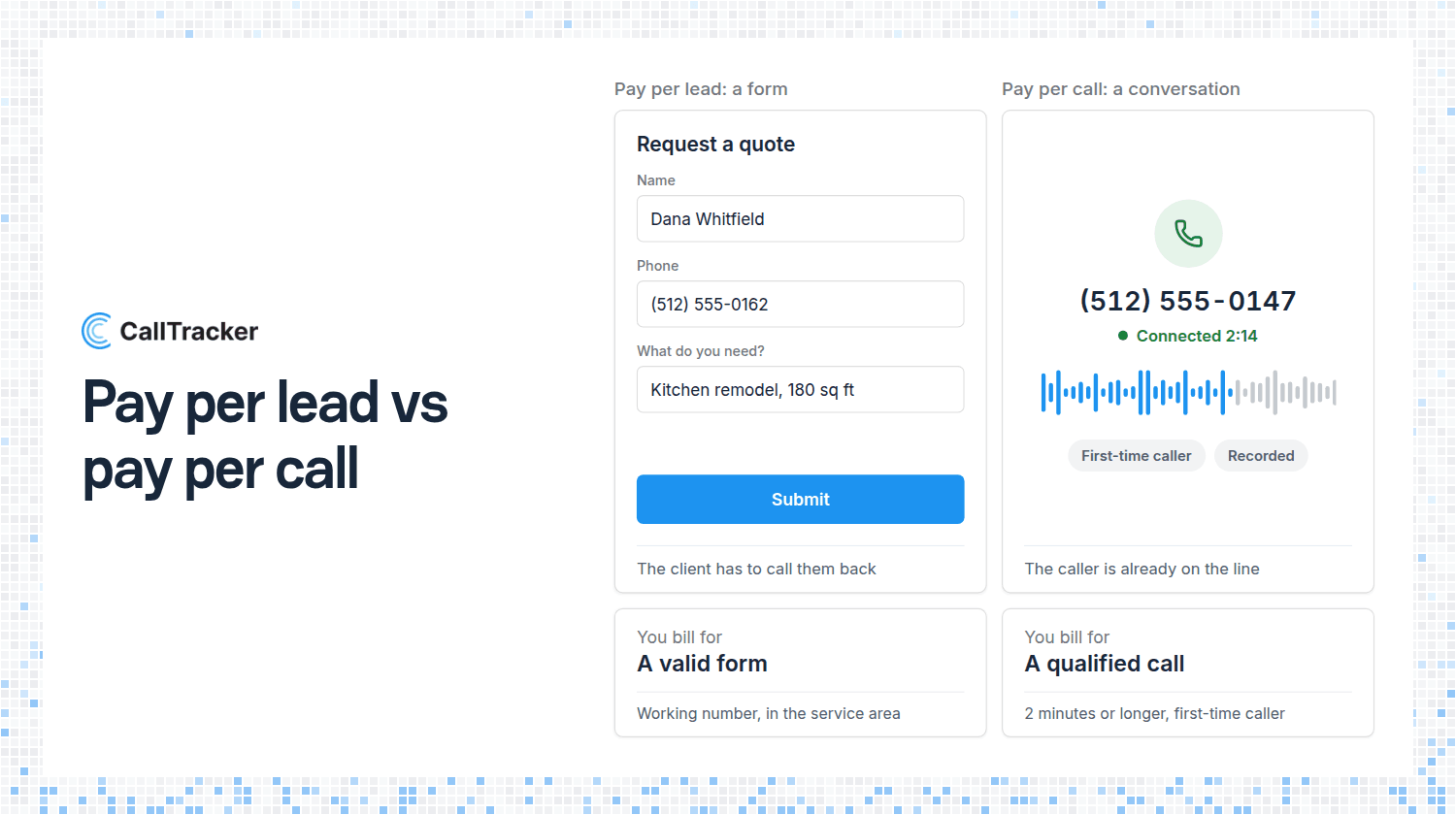
For a local agency that almost always means a form. A homeowner fills in a name, a phone number and a few lines about the job, the record lands in the client’s inbox or CRM, and you bill for it. The client then has to call the person back, and the lead is only worth something if they answer.
What Pay Per Call Delivers
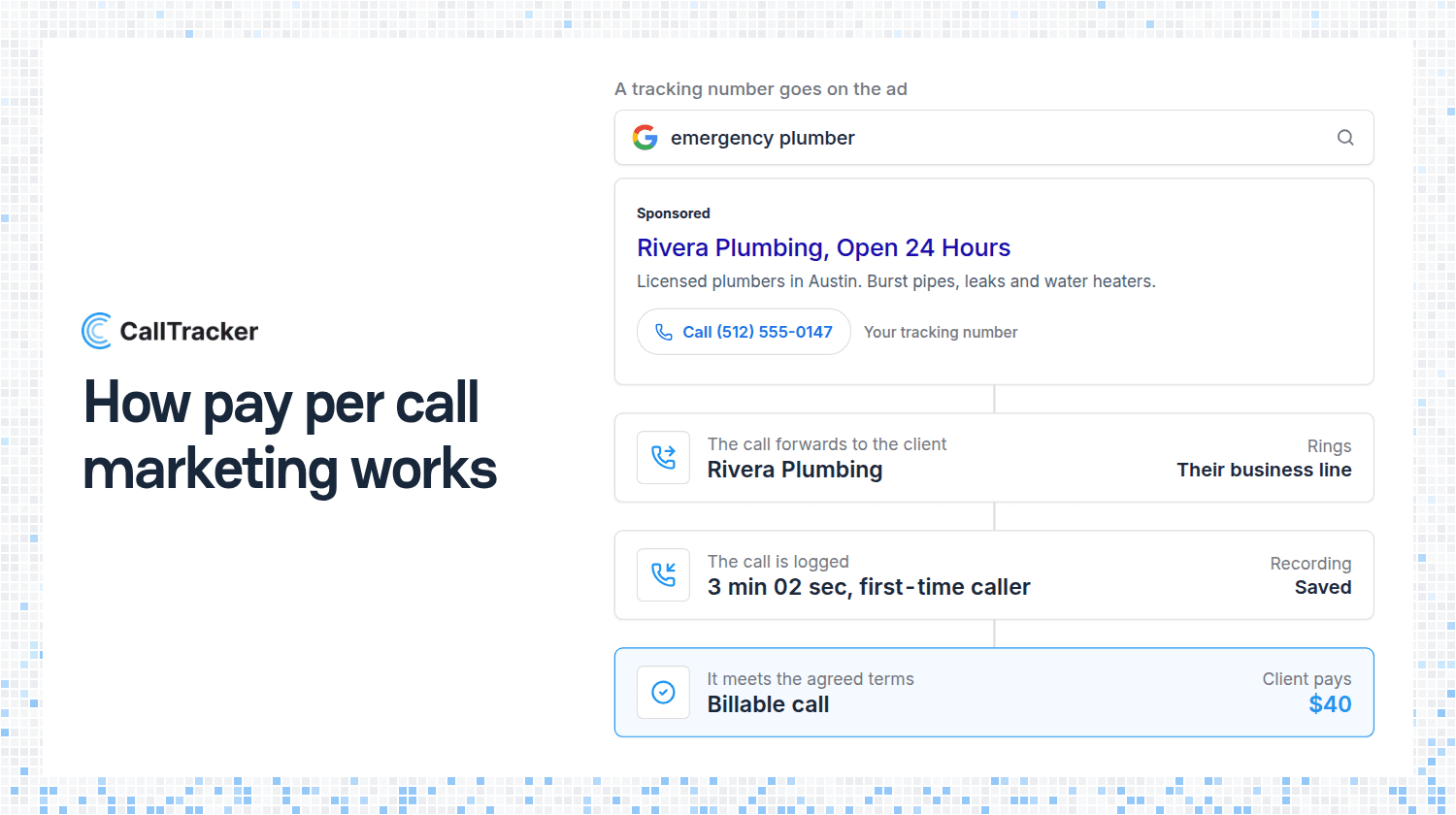
In pay per call the deliverable is the conversation itself. A tracking number on the ad forwards to the client, the caller is on the line with the business within seconds, and the call is billed if it meets the terms, typically a minimum duration and a first-time caller. Our guide to pay per call marketing covers the mechanics and the billing terms in full.

Five Differences That Decide the Choice
- Who makes the next move. A form lead waits for the client to call back. A call lead is already talking to them. A client who is slow to follow up will get more from calls than from forms.
- How the result is proved. A form is proved by its fields: a real name, a working number, a job inside the service area. A call is proved by its duration and its recording. A recording is harder to argue with than a form, because both sides can listen to it.
- What junk looks like. Form programs fight fake submissions and mistyped numbers. Call programs fight robocalls, telemarketers and existing customers calling back. Each needs its own filter.
- How the client has to be set up. Calls need someone answering the phone during the hours the ads run. A missed call is a paid lead with nobody on the other end. Forms can arrive at midnight and be handled in the morning.
- What you can charge. A call skips the callback step, so the client is buying something closer to a booked job. That supports a higher price per result, and it also means fewer results for the same ad spend. Price each from the client's own close rate and job value, not from a rate card.
Urgent Services Fit Calls, Considered Purchases Fit Forms
The split usually follows how fast the customer needs an answer.
Someone with a burst pipe, a locked car or a dead furnace is not going to fill in a form and wait. They call the first business that looks credible, and they often hire whoever answers. Plumbing, towing, locksmith, appliance repair and restoration work are natural pay per call clients for that reason.
Someone pricing solar panels, a kitchen remodel or a legal matter is comparing options over days or weeks. They are willing to leave their details and be called back, and the client often wants the written details before the conversation. Those clients fit pay per lead, or a program that bills both.

Many Programs Bill Both, at Different Prices
Most landing pages have a phone number and a form, and the visitor picks. Selling both is fine as long as the agreement treats them as two products:
- Separate prices. A qualified call and a submitted form are not worth the same to the client.
- Separate terms. Duration and first-time caller for calls. Valid contact details and service area for forms.
- One person, one charge. A visitor who submits the form and then calls ten minutes later is one lead. Say which one is billed.
- One report. The client should see calls and forms side by side for each campaign, or the cheaper lead type will always look like the better deal.
Where Call Tracker Fits
Call Tracker covers the call side. It does not capture web forms, so form leads stay in your form tool or CRM. For the calls it gives you:
- A number per source, with dynamic number insertion on the landing page so a call carries the channel and keyword that produced it.
- A value on billable calls. Set a Default Answered Call Value on a tracker and answered calls of two minutes or longer are valued automatically.
- A first-time caller flag on every call, so repeat callers are easy to exclude.
- A recording and an AI transcript behind each charge.
- A CSV export of the billable calls, and webhooks to push each call into the same CRM your form leads go to.
Frequently Asked Questions
What is the difference between pay per lead and pay per call?
Pay per lead bills for a contact record, usually a form the client has to call back. Pay per call bills for a live phone conversation that met agreed terms such as a minimum duration.
Is pay per call better than pay per lead?
It depends on the service. Urgent services suit calls, because the customer wants to speak to someone now. Considered purchases suit forms.
Can an agency sell both pay per lead and pay per call?
Yes. Treat them as two products with separate prices and terms, and state which is billed when one person both submits a form and calls.
Put a Number on the Calls First
If a client’s landing page already has a phone number on it, some of the leads you produce are arriving as calls that nobody is counting. Put a tracking number on that page and you will know within a month how many there are, how long they last, and what they are worth. Start a 14 day free trial of Call Tracker, from $37 a month with unlimited users.

Alex Phelps
Published on