Call Tracker
See what makes your phone ring.
Every call tied back to the campaign, keyword, and ad that drove it. Call recording, SMS, and real time reporting included.
Unlimited users. No contracts.
Pay Per Call Marketing: How It Works
Pay per call marketing is a model where the advertiser pays for each qualified inbound phone call, instead of paying for clicks, impressions or a monthly retainer. You run the ads, the phone rings at your client’s business, and you bill for the calls that meet the terms you agreed.
For an agency, that is an easy offer to sell and a hard one to run. The client only pays for results, so every invoice depends on proving which calls came from you and which of them counted. This guide covers how the model works, what makes a call billable, how to price it, and what you need in place before the first invoice. We make call tracking software, so weigh the product section with that in mind.
What Pay Per Call Advertising Is
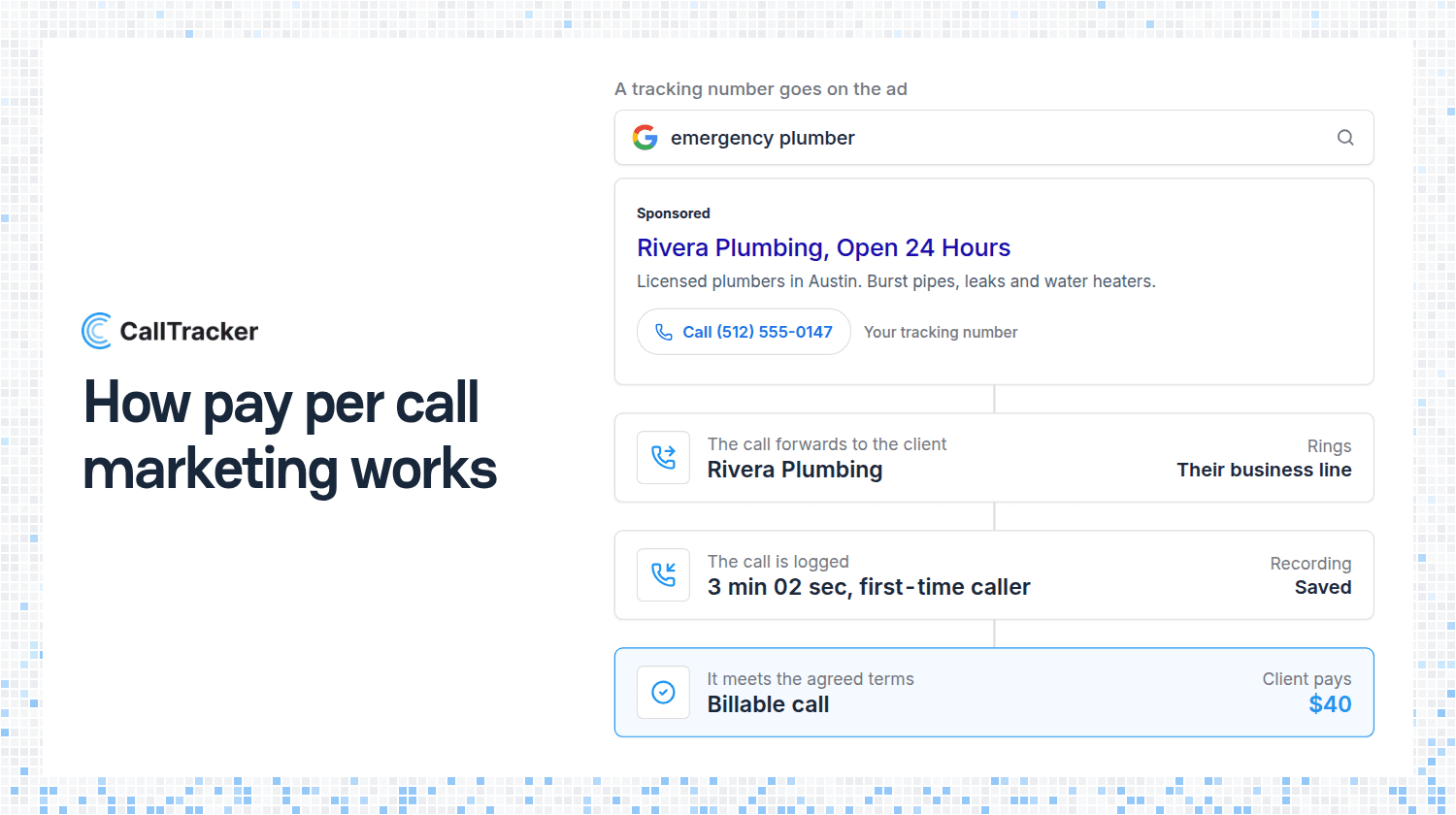
Ringba, a call tracking platform built for this model, describes it as a way for businesses to buy inbound phone calls from consumers who are interested in what they sell. The mechanics are the same in every version of the model:
- A tracking number goes on the ad. The number belongs to whoever is generating the call, not to the business receiving it.
- The call forwards to the buyer. The caller reaches the business as normal and never sees the handoff.
- The call is logged. Source, time, duration, caller and a recording are captured on the way through.
- Qualified calls are billed. A call that meets the agreed terms is charged at the agreed price. The rest are free to the buyer.
Networks and Agency Programs Are Different Businesses
Most of what is written about pay per call describes the network model. A publisher (or affiliate) generates calls, a network brokers them, and an advertiser’s call center buys them, often with several buyers bidding for the same call in real time. Insurance, debt and legal calls are commonly traded this way.
An agency-run program is simpler. You have a direct relationship with a plumber, a roofer or a law firm. You build the campaigns, own the tracking numbers, and send every call to that one client. There is no network, no bidding and no second buyer. This is the version most local agencies mean by pay per call lead generation, and it is the one this guide is about.

The distinction matters when you pick software. Call trading needs routing to multiple buyers, bidding and publisher payouts. A direct program needs attribution, proof and a clean report. Our comparison with Ringba goes through that split.
What Counts as a Billable Call
This is the part to settle in writing before any ad runs. A call is billable when it meets every condition in your agreement, and the usual conditions are:
- A minimum duration. Wikipedia's entry on the model says advertisers are generally billed only for calls of at least one minute. The pay per call provider Soleo puts the typical requirement at 90 to 180 seconds, varying by industry. Longer thresholds filter out wrong numbers and price shoppers.
- A first-time caller. An existing customer calling back about an appointment is not a new lead, so most agreements bill each caller once.
- Answered by the client. Decide who carries the cost of a missed call. If the client does not pick up, you still delivered the lead.
- Inside the service area and hours. A call from two states away, or at 3am for a business that closes at 5pm, is usually excluded.
- A real enquiry. Telemarketers, job seekers and robocalls are never billable.

Duration is popular because it is objective. Nobody has to listen to the call to decide. It is also imperfect: a two minute call can be a wrong number with a chatty receptionist. Keep the recording so either side can check.
How to Price Pay Per Call Leads
Work backwards from what a call is worth to the client. Take a plumber with an average job of $400 who books 40% of qualified calls. Each qualified call is worth $160 in revenue. At $40 a call, the plumber pays $100 in marketing per booked job.
Then check your own side. If your ads produce a qualified call for $22, you keep $18 a call. If one call in four fails the terms, your real cost per billable call is higher than the ad platform reports, and the margin has to cover it. Those numbers are an illustration, not a benchmark: run them with the client’s real close rate and job value, and revisit the price after the first month of data.

What You Need Before the First Invoice
- A tracking number per client and per source. One number for Google Ads, one for the landing page, one for the direct mail piece. That is how you know which spend is producing billable calls.
- Duration and status on every call. Without them you cannot apply the terms.
- A recording of every call. It is the evidence when a client disputes a charge. Recording consent rules vary by state, so play a notice at the start of the call.
- A way to mark what was billed. A value on the call, a tag, or both.
- A report the client can read. The invoice should match a list of calls they can open and listen to.
Running a Pay Per Call Program in Call Tracker
Here is what the product does for this model, and what it does not.
Each client is its own company. Multiple companies keeps every client’s numbers, calls and users separate on one account, and the Agency plan adds white label so the client signs in on your domain under your logo.
Billable calls can be valued automatically. Set a Default Answered Call Value on a tracker and every answered call of two minutes or longer gets that value. Put your price per call in that field and the Calls by Value report becomes a running total of what the client owes, by tracker.
Exceptions are one click. Open a call in the review panel, listen or read the transcript, and change the value or add a tag such as Billable or Disputed without leaving the list.
Repeat callers are flagged. Every call records whether the caller has phoned that company before, and you can filter the call log to first-time callers.
The invoice backup is an export. Filter to one client, one date range and a value above zero, then export to CSV. Each row carries the duration in seconds, the status, the first-time flag, the value and a link to the recording.
The client sees it without asking. Invite the client as a user, at no cost on any plan, and schedule a daily, weekly or monthly summary email to them.
What it does not do: the two minute threshold is fixed, so a 90 second agreement means sorting the export by duration instead. There is no routing by business hours or caller location, no call caps, and no bidding or routing between multiple buyers. If you sell the same call to whichever buyer pays most, you need a call trading platform.
Frequently Asked Questions
What is pay per call marketing?
It is a model where the advertiser pays for each qualified inbound phone call rather than for clicks or a retainer. A tracking number on the ad forwards to the business, and calls that meet the agreed terms are billed.
What makes a call billable in pay per call?
Whatever the agreement says. The common terms are a minimum duration, a first-time caller, a call from inside the service area during business hours, and a real enquiry.
Do agencies need a pay per call network?
No. A network brokers calls between publishers and many buyers. An agency with a direct client can run its own program with tracking numbers, recordings and a report of billable calls.
Start With One Client and One Number
Pick the client whose phone already rings, put a tracking number on one campaign, and set the price per call as the default call value. After a month you will have a list of billable calls with a recording behind each one, which is everything a pay per call invoice needs. Start a 14 day free trial of Call Tracker, from $37 a month with unlimited users, or $147 a month with white label and unlimited client companies.

Alex Phelps
Published on