Call Tracker
See what makes your phone ring.
Every call tied back to the campaign, keyword, and ad that drove it. Call recording, SMS, and real time reporting included.
Unlimited users. No contracts.
Invoca vs CallRail: Pricing, Scale, and Who Each One Is Built For
Invoca and CallRail are both call tracking platforms, and they are sold to completely different buyers. Invoca publishes no prices and routes every enquiry through a sales meeting. CallRail publishes four plans and lets you sign up this afternoon.
If both are on your shortlist, one of them is almost certainly the wrong size for you. This comparison is mostly about working out which.
Call Tracker publishes this comparison and competes with both. Details below come from each provider’s own pages, and both are linked so you can verify the current figures.
The Short Answer
Choose Invoca if you are an enterprise brand or a pay-per-call operator, you need thousands of numbers a year, and AI classification of what happened on each call is central to how you buy media.
Choose CallRail if you want a published price, a card-and-signup purchase, and attribution for a business rather than a media operation.
Consider Call Tracker if you want CallRail’s self-serve model with more included usage at a lower price.
Invoca vs CallRail at a Glance
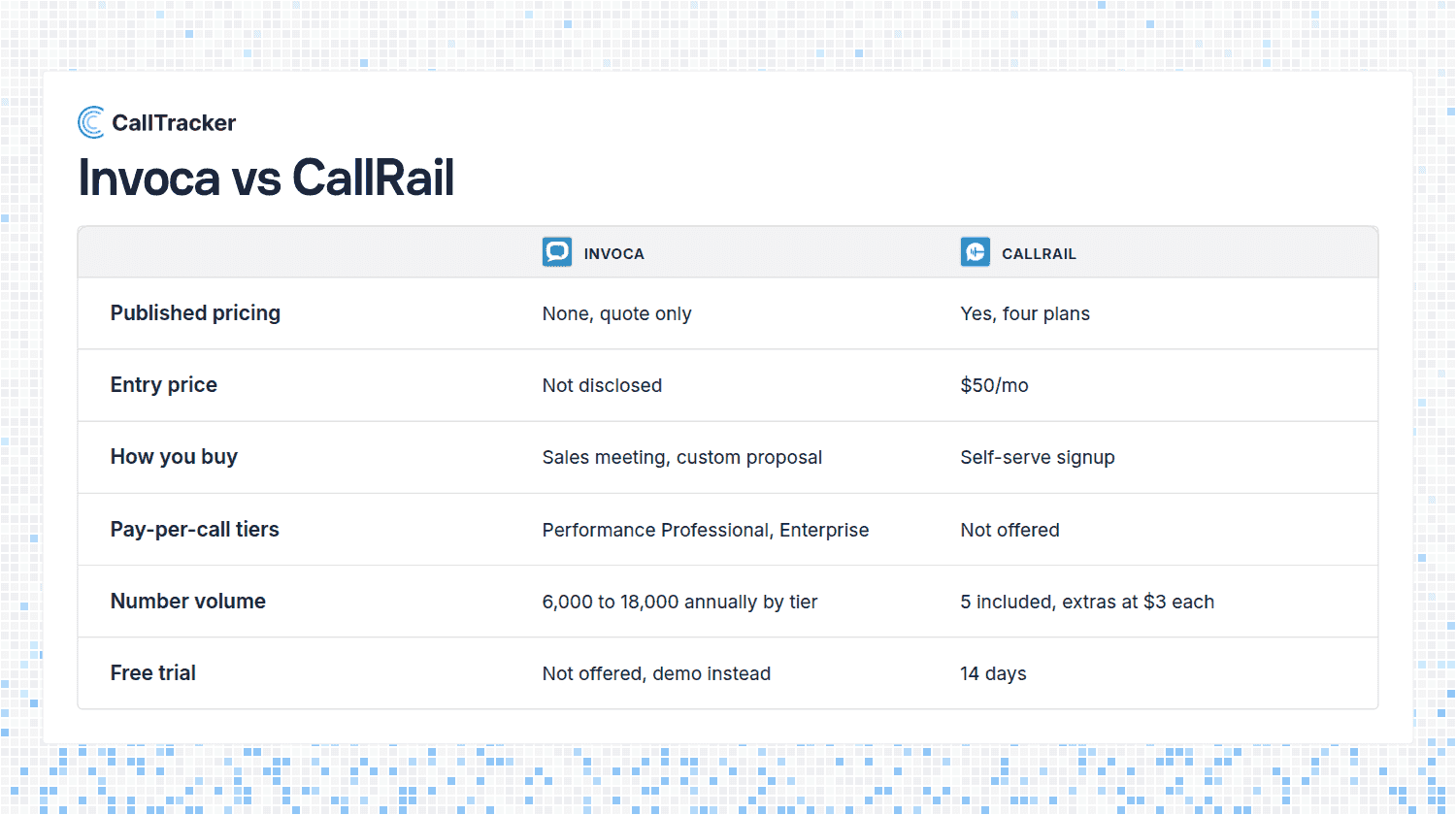
| Category | Invoca | CallRail |
|---|---|---|
| Published pricing | None, quote only | Yes, four plans |
| Entry price | Not disclosed | $50/mo |
| How you buy | Sales meeting, custom proposal | Self-serve signup |
| Plan structure | Pro, Enterprise, Elite (brands and agencies) | Lead Tracking through Lead Conversion Complete |
| Pay-per-call tiers | Performance Professional, Performance Enterprise | Not offered |
| Number volume | 6,000 to 18,000 annually by tier | 5 included, extras at $3 each |
| AI call analysis | Custom Signals, 5 to 100 by tier, Signal AI add-on | Conversation intelligence from $150/mo |
| Add-ons | Signal AI, Quality Management, PreSense | Form tracking and conversation intelligence via tiers |
| Free trial | Not offered, demo instead | 14 days |
Check the Invoca pricing page and the CallRail pricing page for current details.
The Pricing Model Is the Whole Story
Invoca’s pricing page lists tiers with no dollar amounts attached. Each one carries a “Get Your Quote” button, and the page explains that “Invoca’s pricing is based on a few specific factors” before inviting you to a short meeting.
That is not evasion, it is a deliberate enterprise motion. Pricing is negotiated against volume, contract length, and which add-ons you take. Expect an annual commitment and a procurement process.
CallRail publishes $50, $95, $150, and $195 a month. All four plans include the same 5 local numbers, 250 local minutes, and 25 texts, with overages at $3 per extra number and $0.05 per local minute. Our CallRail pricing breakdown works through what that means on a real bill.
The practical consequence: you can know your CallRail cost in thirty seconds and your Invoca cost in about three weeks.
Scale Is the Honest Dividing Line
Look at the number volumes rather than the feature lists.
Invoca’s tiers are sized at 6,000, 12,000, and 18,000 phone numbers annually. Those are figures for national advertisers, insurance and healthcare networks, automotive groups, and pay-per-call marketplaces routing enormous inbound volume.
CallRail’s entry plan includes five numbers. Its whole model assumes you will need tens, not thousands.
If your account needs a few dozen numbers, Invoca’s smallest tier is built for roughly a hundred times your requirement, and you will be paying for that headroom. If you genuinely need thousands of numbers and per-call outcome classification feeding your bidding, CallRail is not the tool and its overage rates will tell you so quickly.
AI Call Analysis Is Where Invoca Earns Its Price
Both platforms analyse calls. They do it at different depths and for different purposes.
CallRail’s conversation intelligence arrives at the $150 Lead Conversion tier and covers call summaries, sentiment analysis, trend reports, and automatic conversion tagging. That is aimed at a marketer who wants to understand call quality.
Invoca sells Signals: custom classifications of what happened on a call, from 5 on the Pro tier to 100 on Elite, with Signal AI available as a paid add-on. Quality Management and PreSense are also sold separately. The purpose is different. Signals exist to feed automated decisions, pushing verified call outcomes back into ad platforms so bidding optimises on revenue rather than call volume.
That is worth real money if you spend heavily on paid media. It is worth very little if you run a local service business.
Which One Should You Choose?
Invoca is the better choice when:
- You are an enterprise brand or a pay-per-call operator.
- You need thousands of tracking numbers a year.
- Call outcome data needs to drive automated media bidding.
- You have procurement capacity for an annual contract.
CallRail is the better choice when:
- You want a published price and a self-serve signup.
- Your number requirement is in the tens.
- You want to start today rather than after a demo cycle.
- Attribution matters more than automated bid feedback.
For most readers of a comparison like this, the answer is CallRail or something like it. Invoca is excellent at what it does and is priced for a buyer with a media budget to match.
A Lower-Cost Self-Serve Alternative
If Invoca is oversized and CallRail’s allowance is undersized, that gap is the one Call Tracker was built for.
Starter is $37 a month with 10 local numbers, 500 local minutes, and 100 inbound texts, which is double CallRail’s included numbers and minutes for $13 less. Every feature is on every plan, so call recording, call analytics, call flows, whisper messages, and voicemail need no upgrade. AI transcription usage is $0.02 per minute.
The $147 Agency plan adds white-label branding and unlimited client companies.
Call Tracker is not an Invoca replacement. There is no Signals equivalent, no pay-per-call marketplace tooling, and no automated bid feedback loop. If those are why you are looking at Invoca, take the demo. If you are looking at Invoca because you outgrew a small plan, see the Invoca comparison, the CallRail comparison, or the eight best alternatives.
Frequently Asked Questions
How much does Invoca cost?
Invoca does not publish prices. Its pricing page lists tiers with a “Get Your Quote” button and arranges a meeting to build a custom proposal based on your volume and requirements.
Does Invoca offer a free trial?
No. The published route is a quote request or a booked demo, unlike CallRail’s 14-day trial.
Is Invoca better than CallRail?
Neither is better in the abstract. Invoca is built for enterprise media operations needing thousands of numbers and AI call classification. CallRail is built for businesses that want self-serve attribution at a published price.
What are Invoca Signals?
Signals are custom classifications of what happened on a call. Invoca’s tiers include 5, 50, or 100 custom Signals, with Signal AI sold as an add-on.
Which is cheaper?
CallRail, in every realistic scenario. It starts at $50 a month with no contract, while Invoca is an annual enterprise agreement sized for thousands of numbers.
See the Numbers on Your Own Account
Neither a quote nor a pricing page tells you what your calls will cost. Start a 14-day free trial, run real calls through it, and compare against whatever proposal you have in hand.

Alex Phelps
Published on